
Waiting for Ohio
Four years and $52.7 billion later, the flagship factory won't produce a chip until the 2030s.

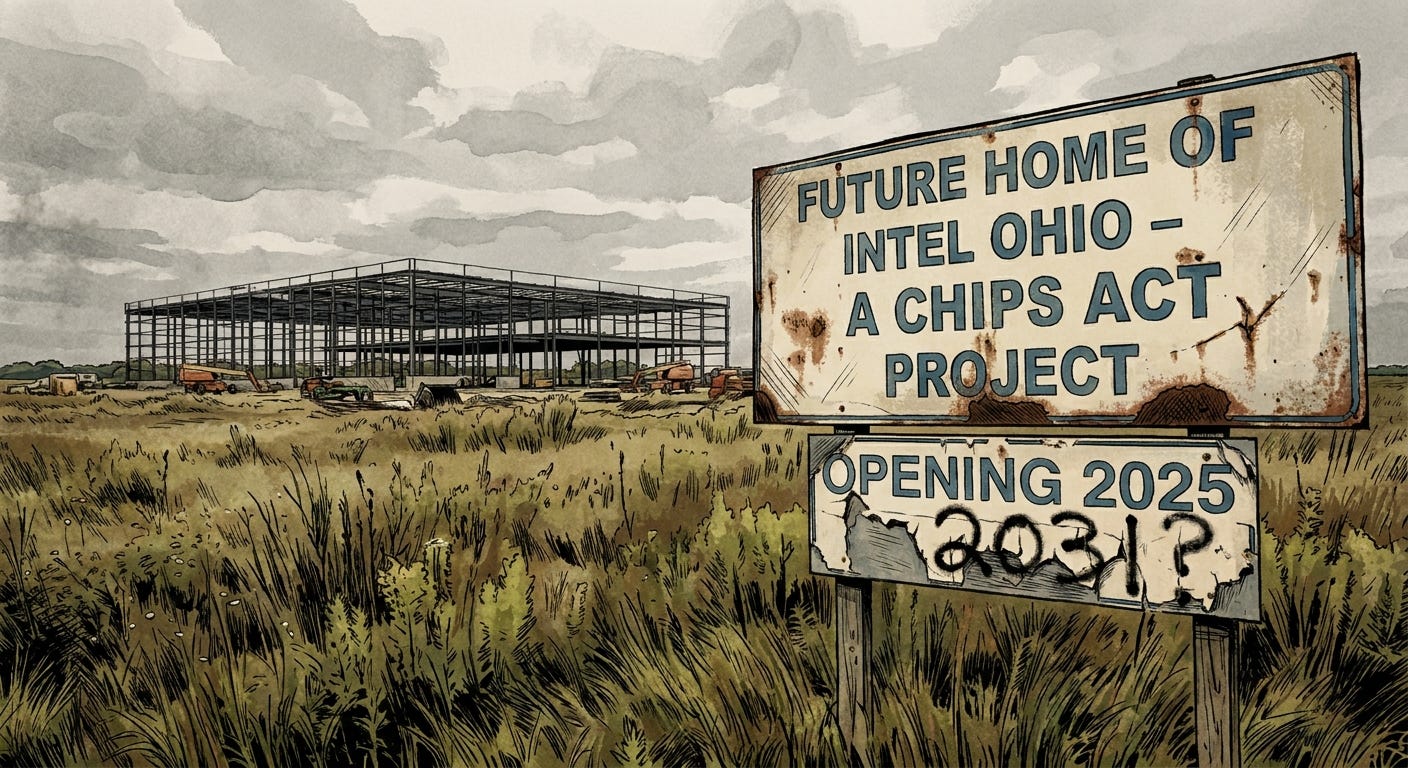
On September 9, 2022, Joe Biden stood in a field outside New Albany, Ohio, in a hard hat, and called it “a Field of Dreams.” Intel had promised the largest private investment in Ohio history: $20 billion for two chip factories, 3,000 permanent jobs at $135,000 a year, 7,000 construction jobs, production by the end of 2025. The president was there to sell the CHIPS and Science Act, signed into law a month earlier: $52.7 billion in public money to reshore semiconductor manufacturing and break American dependence on Taiwan. Semiconductors are the chips in every phone, every car, every missile guidance system. You do not leave the house without touching a dozen of them. You could watch the ceremony and believe the deal was already done. The money appropriated, the ground broken, the factories rising.
If you lived in Licking County, someone you knew quit their job to join the hiring line. The factories haven’t risen. Intel now says its first Ohio plant won’t begin operations until 2030 or 2031. Its second plant, 2032. The company has spent over $1.5 billion in Ohio in 2025 alone and poured 6.4 million hours of construction labor into the site. It has also shed 46,800 workers from its global workforce since 2022, lost $18.8 billion in a single year, fired its CEO, suspended its dividend, and accepted a 9.9% government equity stake to stay afloat. Intel hasn’t bought back a single share since early 2021, well before the CHIPS Act existed, because it cannot afford to.
The CHIPS Act failed because tying public goods to private balance sheets means public goods rise and fall with the stock price. This is the contradiction at the heart of industrial policy under capitalism: the public absorbs the risk and the upfront cost, capital retains control, and the promised goods are whatever is left over after the balance sheet gets its cut.
The CHIPS Act is often discussed as a national security measure: break dependence on Taiwan before China does something. But the national security frame obscures the economic dynamic underneath. This is industrial policy, which is always a negotiation between public purpose and private control, and the CHIPS Act was structured to leave control with the private side. The public puts up the money. The company decides whether and when to build. The milestones protect against fraud but leave failure unaddressed. The jobs exist on paper; the production recedes into the next decade. The CHIPS Act subsidizes shareholders. Every argument about competing with China describes the same transaction to a different audience.
The same dynamic plays out in green energy tax credits that accelerate corporate profits without hitting emissions targets, in infrastructure bills that fund toll roads operated by private consortia, in stadium subsidies where the team moves anyway. The mechanism is always the same: the public bears the cost, the private actor decides the pace, and what the public gets in return is whatever is left over. The CHIPS Act is the latest and most expensive version of a story Americans have been living through their entire lives: a story in which the public investment is guaranteed and the public benefit is not.
The CHIPS and Science Act passed the Senate 64 to 33 and the House 243 to 187 in July 2022. Biden signed it August 9. Division A puts $52.7 billion on the table: $39 billion of it in direct factory subsidies, the rest split across R&D and workforce programs. The money does not move until construction and production milestones are verified. A 25 percent investment tax credit sweetens the deal. The bill also drew lines in the sand: no CHIPS dollars can touch buybacks or dividends; any company that expands semiconductor manufacturing in China forfeits every cent it received; and workforce training pledges are attached to every award. The Congressional Research Service published the full breakdown in April 2023.
Read on paper, this is a serious attempt to attach public conditions to public money. The safeguards prevent fraud. They leave collapse unaddressed. The mechanism that was supposed to protect taxpayers (pay only upon delivery) turns out to protect the program from delivering anything at all.
Four years after passage, the CHIPS Program Office has announced roughly $33.7 billion in awards across twenty companies. The actual cash disbursed is approximately $2.2 billion: nearly all of it to Intel. That is a 6.5 percent disbursement rate. More than 93 percent of the announced manufacturing incentives remain in the Treasury. The Government Accountability Office found in January 2026 that the program had not fully implemented fraud prevention best practices. The Commerce Department declined to concur with GAO’s recommendations, the only agency among those reviewed to refuse.
This is the dynamic Mariana Mazzucato documents across industry after industry: the state absorbs the risk and the upfront investment, the private sector captures the reward. Her book The Entrepreneurial State made the case that most foundational technologies, from the iPhone’s components to the algorithms behind modern AI, were built on publicly funded research and then enclosed by private capital. The CHIPS Act is the Mazzucato model in semiconductor form.
The projects tell the story. Intel’s Ohio site is the flagship failure: a company that lost $18.8 billion in a single year and saw its foundry division burned $7 billion in 2023 was supposed to deliver the largest private investment in Ohio history.
Samsung’s Texas fab won a preliminary award of $6.4 billion, then saw it cut to $4.745 billion during renegotiations, a 26 percent reduction. Its production timeline slipped; mid-construction, Samsung changed which generation of chips the plant would make, requiring new tooling and a redesign of equipment already in place. Micron’s New York megafab broke ground two years late; first production is now targeted for 2030, and the second plant may not open until 2033.
TSMC is the exception. Its Arizona fab is producing on schedule with yields matching the company’s Taiwan facilities. TSMC is financially healthy. It has committed an additional $100 billion to its US operations, on top of an earlier $65 billion. When the company receiving the subsidy is solvent, the milestones work. Public goods tied to private firms track the firm’s fortunes.
The Trump administration called the CHIPS Act “a horrible, horrible thing” and began renegotiating signed contracts. Dozens of NIST employees working on CHIPS initiatives were fired. Congressional Republicans have proposed cutting NIST’s budget. At the same time, the administration praised Texas Instruments’ $60 billion expansion and fast-tracked TSMC.
The renegotiations reveal what the bill’s structure already implied. The buyback prohibition applied only to the subsidy dollars themselves, leaving company funds untouched. The China guardrails carved out legacy-chip exceptions. The worker training provisions were non-binding “sense of Congress” language. The bill was built to be palatable to the industry it was subsidizing, and even those palatable terms are now being reopened. The bargains that structure the public’s investment in private chip production are contingent on which administration is in power and which company has leverage. Deals get renegotiated.
The deeper problem is that even if the original terms held, they wouldn’t solve the structural issue. Tighter buyback restrictions would not have made Intel solvent. Stronger workforce requirements would not have prevented 46,800 layoffs. Private balance sheets make decisions that are rational from the shareholder’s perspective. Intel delayed its Ohio plant because pouring billions into a factory while your core business is losing $18.8 billion a year is a fast way to get sued by your investors. The company did exactly what the system incentivizes it to do.
The Fork
There is an alternative to negotiating public goods out of private firms, and it is already visible under the CHIPS Act itself. The same bill enabled a $3 billion “Secure Enclave” program that pays Intel to produce advanced chips exclusively for the U.S. government under dedicated trusted manufacturing processes. The government is already buying production capacity under its own direction. The step from paying a private company to run a government-only production line to owning that line outright is a political choice.
The United States has done this before, in other sectors, at larger scale. In 1935, nine out of ten rural Americans had no electricity. The power companies had run the numbers and decided those customers weren’t worth the wire. The Rural Electrification Act financed the buildout, and within fifteen years the American countryside was lit. The private sector said no; the public sector did it anyway. The same story runs through Nebraska’s all-public power grid (rates 40 percent below the national average, governed by elected boards) and Chattanooga’s publicly owned broadband network, which built the fastest internet in the Western Hemisphere after private ISPs refused.
The semiconductor industry itself was built this way. In the mid-1980s, Taiwan decided it wanted a domestic chip industry and recruited Morris Chang, a veteran of Texas Instruments who had already spent decades in American semiconductors, to build one. American chip giants wouldn’t touch it. The Taiwanese state funded nearly half the venture and promised Chang the rest would follow. The result was TSMC: today the most strategically critical manufacturer on the planet, the factory behind Apple, Nvidia, and virtually every advanced chip designer. Private capital said no at every stage. The state built it anyway.
The CHIPS Act tried to split the difference: public money, private control, conditions attached. Four years in, the flagship project is years from completion, the money mostly unspent, and the primary lesson is that conditions are a substitute for control, and an inadequate one. Strings buy compliance; outcomes require ownership. At some point you have to own the means of production, or accept that you do not control what gets produced.
The groundbreaking in Ohio was real. The concrete was poured, the steel went up, 4,500 native trees were planted along the site boundary. The 162 Intel employees showed up. They are training at other facilities, waiting for a factory that has slid from 2025 to 2031. The workers kept their end of the deal. The question is whether the next one comes with ownership, or more conditions.
CommonBytes
This column explores a central question: What should technology’s role be in a world beyond capitalism? Today’s technological landscape is largely shaped by profit, commodification, and control—often undermining community, creativity, and personal autonomy. CommonBytes critiques these trends while imagining alternative futures where technology serves collective flourishing. Here, we envision technology as a communal asset—one that prioritizes democratic participation, cooperative ownership, and sustainable innovation. Our goal? To foster human dignity, authentic connections, and equitable systems that empower communities to build a more fulfilling future.
I know this may not have been your focus, but the $60M Intel received from OH for doing absolutely still bothers me. That was not a legal loophole. That was an affirmative decision.