

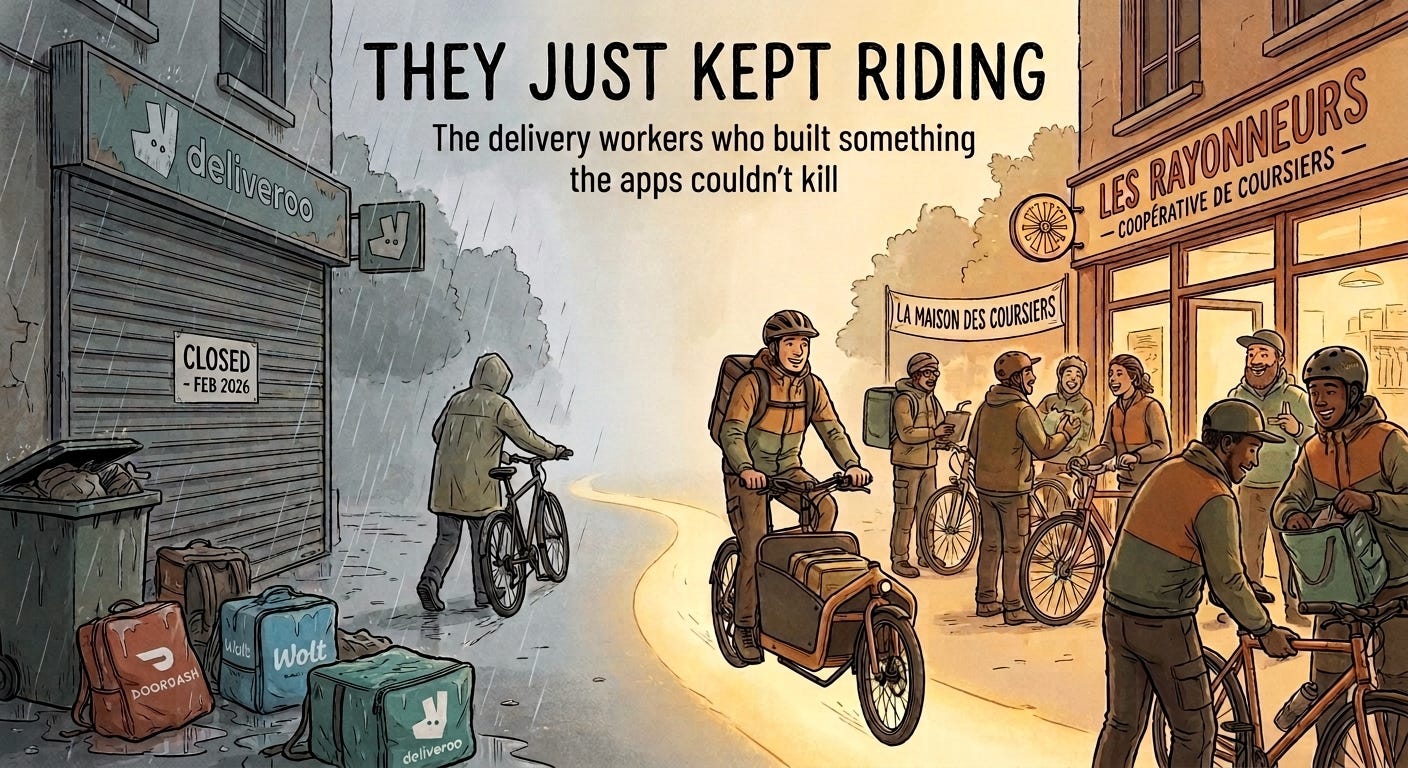
In February 2026, DoorDash announced it was pulling its Deliveroo and Wolt brands out of four countries: Qatar, Singapore, Japan, and Uzbekistan. The acquisition of Deliveroo had closed less than five months earlier, at a price of $3.9 billion. The company called it a strategic realignment. The money that had been subsidizing food delivery in those markets was no longer worth spending.
That same month, in Angers, France, a small bike delivery collective called K’Liveo was voting to become a worker-owned cooperative. K’Liveo had liquidated in April 2025. The riders, dispatchers, and mechanics who remained bought the equipment at auction and restarted. They renamed it Les Rayonneurs: the Radiators.
You have probably never watched someone seal a delivery bag in the rain outside an Angers restaurant at 9 p.m. But you know these workers. They exist in every city, in every weather, on every platform that claims they don’t employ anyone. For eight years, while venture capital set billions of dollars on fire trying to corner the food delivery market, a network of them has been building a model that doesn’t need the subsidies to last.
That network has a name. CoopCycle began in Paris in 2017, founded by activists and ex-couriers who had watched the platform economy burn through their industry. The immediate catalyst was the bankruptcy of Take Eat Easy, a Belgian delivery platform that shut down in 2016 and left its riders stranded without pay or severance. Some of those riders decided they would never again depend on a platform they didn’t control.
What they built is a federation now spanning more than 70 cooperatives across at least 12 countries, with active expansion into Latin America. The software is publicly available, but its license restricts commercial use to worker-owned businesses. DoorDash can’t simply copy what the cooperatives built. Each local cooperative runs the platform on its own servers. There is no central company, no corporate headquarters, no shareholders extracting a cut.
“We prefer to have more open discussions with the riders,” one cooperative manager told researchers. “What do you consider good work? What are your strengths? Why do you think you excel at them?”
Riders are employees with full labor protections. The software was built without the mechanisms that turn workers into throughput: no rating system, no surge pricing, no algorithm deciding who rides. The federation has also built what no VC platform ever would — La Maison des Coursiers, a drop-in center in Paris since 2021 and now expanded to Bordeaux, has supported hundreds of couriers with legal aid, training, and community.
The venture-funded model is showing its structural limits. DoorDash acquired Deliveroo in an industry consolidation play: buy the competition because organic growth has stalled. Then it started cutting. Four countries exited in a single announcement. Deliveroo had already pulled out of Hong Kong in 2025. The delivery platform business was designed to subsidize growth with investor capital and drive out competitors; the “eventually raise prices” part keeps receding. An analysis framed the question bluntly: “a pivot toward discipline or retreat on global ambition.”
CoopCycle’s model was built for the world where the subsidies stop. It needs enough deliveries to pay its workers and keep the lights on. The surplus stays in the cooperative, in the community, in the hands of the people who generated it.
In Nantes, NaoFood completed a multi-year merger of parcel delivery, food delivery, and a bike repair shop, converting to full worker ownership in early 2026. In Angers, Les Rayonneurs rose from the near-death of K’Liveo because the workers who remained decided they would rather rebuild collectively than scatter individually. The measure of success is whether the workers control their own conditions, whether the surplus circulates locally, whether the model can reproduce itself without depending on a funding round.
For years, the law was on the other side, and the platforms spent whatever it took to keep it there. In 2020, Uber and Lyft poured $200 million into California’s Proposition 22 to overturn a law classifying drivers as employees, and won. In Massachusetts, a gig worker ballot measure was blocked by the state’s highest court in 2022. The playbook was consistent: spend, sue, stall. It worked for a long time.
That is changing. The EU Platform Work Directive, adopted in 2024, creates a rebuttable presumption of employment for platform workers. Member states must implement it by December 2026. For VC platforms built on contractor misclassification, this means massive reclassification costs. For CoopCycle members, who already employ their riders with full protections, the transition cost is zero. The directive prices the core labor arbitrage out of legality.
In California, Governor Newsom signed a law in October 2025 allowing Uber and Lyft drivers to unionize and bargain collectively — a compromise unthinkable five years earlier, when the same companies were spending $200 million to prevent exactly this. In New York, the City Council passed legislation in December 2025 protecting nearly 100,000 drivers from algorithmic deactivation. The wins weren’t given. They were extracted, vote by vote, court case by court case, against companies that built their business model on the assumption that the law would never catch up.
And the political ground is shifting beyond policy. In New York, Mayor Zohran Mamdani — a democratic socialist elected in 2025 — saw his allies sweep congressional primaries this week, ousting two sitting congressmen. One of the winners, Claire Valdez, is a former union organizer.
These are real wins, hard-won. But they are still fights over the terms of extraction: classify us fairly, don’t deactivate us, let us bargain over the cut. The system that pits workers against each other for scraps stays intact. The cooperative model doesn’t negotiate with that system. It replaces it. There is no cut to bargain over because there is no one on the other side of the table.
The model is proving itself beyond food delivery. In New York, The Drivers Cooperative launched in 2021 with 2,500 drivers. It has since grown to thousands more, completed over 300,000 trips, and generated more than $11 million in cumulative revenue, with over $9 million paid directly to drivers, who keep 80% of each fare. The cooperative has opened a Colorado chapter and pivoted to specialize in paratransit and non-emergency medical transportation: a niche VC platforms overlook because it doesn’t scale the way investors demand. It is, instead, the kind of work that matters to people who need a ride to a doctor’s appointment and can’t afford to be treated like a throughput metric. The cooperative achieved a $30 per hour minimum wage guarantee on paratransit contracts, a first in the rideshare industry. In Quebec, the Eva cooperative offers an alternative to Uber using the same template CoopCycle pioneered: open-source infrastructure, federated local ownership, democratic governance.
The platform model didn’t just extract wages from workers and fees from restaurants. It extracted the relationships that make a local economy function: riders reduced to throughput metrics, restaurants to order numbers, customers severed from any sense of who brought their food. Polanyi called this disembedding: markets untethered from the social relations that give economic life its shape. Cooperatives re-embed them. Workers deciding their own conditions. Surplus circulating locally instead of draining upward. Technology that serves the people who use it, licensed so it can’t be repurposed for extraction.
For a decade, the story of the platform economy has been told as an inevitability: disruption, scale, winner takes all. But food delivery is only the most visible case. The same dynamic — extractive platforms burning investor capital then retreating when the subsidies stop — is playing out in rideshare, in cloud services, in content platforms, in any industry where a company inserts itself between workers and customers and calls the cut a business model.
Worker cooperatives outlast conventional businesses (one study found a 7 percent higher survival rate through the first decade), and a growing body of academic research confirms that cooperative platforms deliver better working conditions with reduced algorithmic control. Take Eat Easy collapsed in 2016 and is long forgotten. CoopCycle, founded by its former riders in 2017, now spans four continents, with peer-reviewed studies documenting its adaptation across Latin America. The question is whether workers can build enough of an alternative that when the next platform retreats, there is something already in place. Something that just keeps working. They’re still riding.
CommonBytes
This column explores a central question: What should technology’s role be in a world beyond capitalism? Today’s technological landscape is largely shaped by profit, commodification, and control—often undermining community, creativity, and personal autonomy. CommonBytes critiques these trends while imagining alternative futures where technology serves collective flourishing. Here, we envision technology as a communal asset—one that prioritizes democratic participation, cooperative ownership, and sustainable innovation. Our goal? To foster human dignity, authentic connections, and equitable systems that empower communities to build a more fulfilling future.