

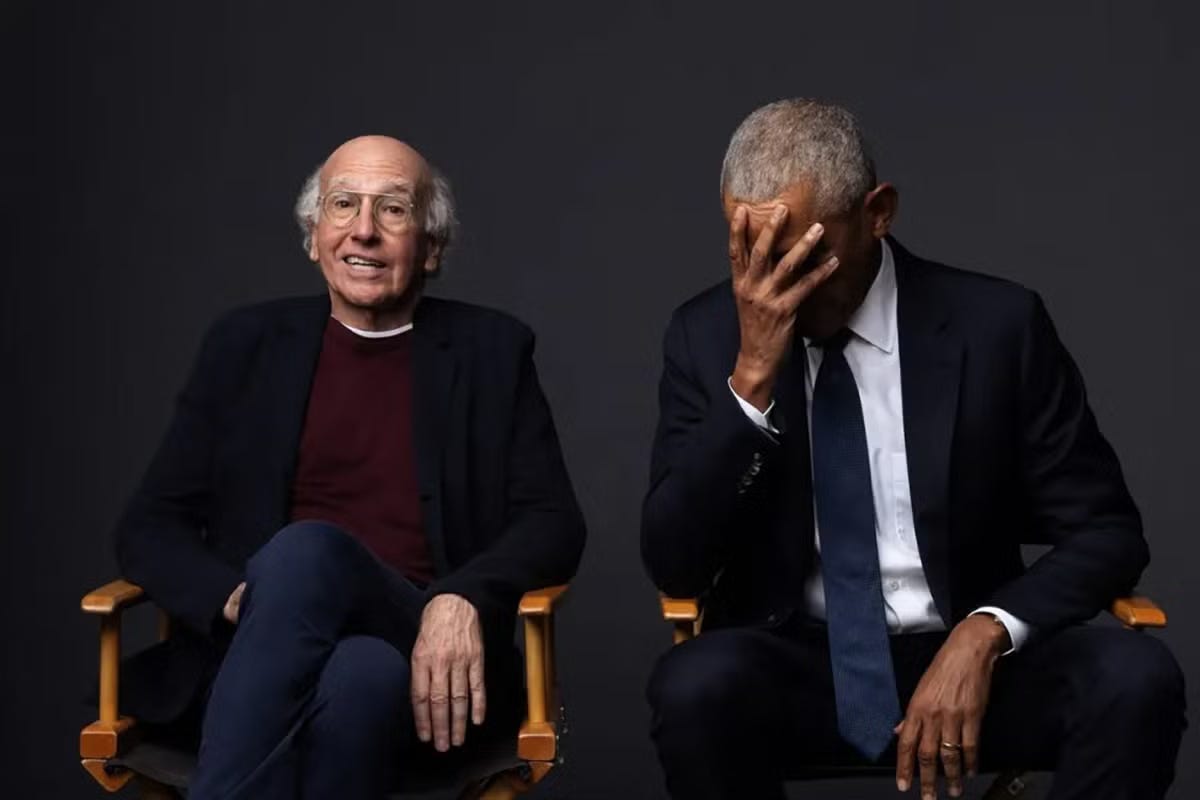
Years ago, my friend and I had a running joke: what if former president Barack Obama guest-starred as himself on an episode of Curb Your Enthusiasm? Obama would commit some minute faux pas, probably wholly unintentionally, that would inflame Larry David’s misanthropy and paranoia. Obama would then respond in an unusually lofty, oratorical manner, further provoking LD’s ire. The possibility of this guest appearance actually happening, we argued, was not so far-fetched. At the time, Trump was bulldozing popular notions of what a president (former or current) could get away with in public, and we were familiar with the photos of Obama and David rubbing shoulders at a fancy golf course on Martha’s Vineyard, a favorite vacation spot for David and the eventual site of Obama’s multi-million dollar summer home. Obama, like other celebrities who played themselves on Curb, could take some welcome dressing-down for his self-importance and petty grievances, while also reminding Americans of his grace and charisma.
It was nonetheless a bit shocking and bizarre when HBO announced Life, Larry, and the Pursuit of Unhappiness, an American history-themed sketch show with David at the helm. Obama will co-produce and actually appear in an episode of the program in an as-yet undisclosed role. It is not out of the ordinary for Obama to slap his name on a mediocre TV show. He’s done plenty of that in his post-presidency, when he’s not kitesurfing with billionaires, creating monuments to himself, or building that aforementioned Xanadu on Martha’s Vineyard. Still, to actually see the leader of the Democratic party palling around with Larry David onscreen is perhaps more jarring than most people would care to admit.
Why should we care about this? For starters, Obama is the de facto leader of the Democratic party. He is one of the most influential and recognizable figures on Earth, and according to some polls one of the most admired. Obama directly involves himself in party politics when he really wants to, notably when he intervened to tank Bernie Sanders’ 2020 primary campaign. He is consulted regularly on party messaging, strategy, and content. This begs the question: how is this an appropriate response to the current moment? Obama is no doubt aware that many of the party’s brightest stars refer to Trump as a fascist. He knows that the illegal war of aggression America is waging against Iran risks the collapse of America’s military and economic supremacy, not to mention global nuclear annihilation. He also knows that most Americans are deeply divided and increasingly radicalized, and that many struggle to afford groceries and earn living wages. For Obama to behave this way publicly, in light of current political and social crises, is quite nauseating. It cancels out the idea of a politics that is not simply theater. Such complacency disarms the growth of mass opposition to injustice. In some cases, it gives rise to disillusionment and despair. For others, it’s a galvanizing reminder that bourgeois politicians are not coming to save us.
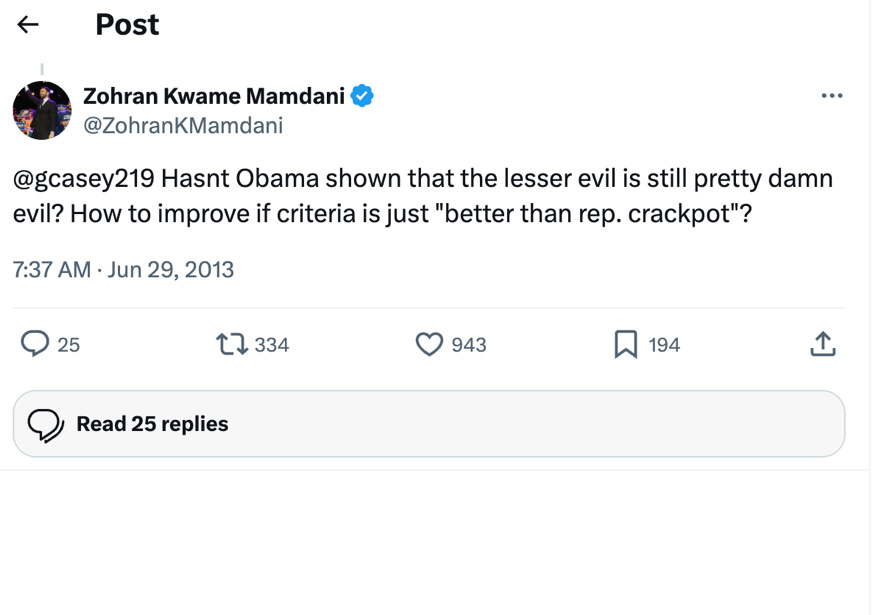
If the warnings that Democrats are giving us about rising fascism and WWIII are true (and there is plenty of evidence that they are), then why is the former leader of the free world spending these critical, extremely ominous months yukking it up with America’s favorite schlemiel? One possible answer is the class character of the Democratic party. There was a time when the Democrats could plausibly describe themselves as a party of the working class. Today, because their donors are overwhelmingly billionaires and war profiteers, they deliberately choose to never invoke the legacy of the New Deal or the Great Society. In public, the Democrats make impassioned speeches about the corporate interests that threaten our country. In private, the Democrats agree not to vote on any measures that would effectively meet those threats, since they (and their Republican counterparts) are in fact captured by corporate interests. The very few party members who do agitate for social-democratic reforms, such as Bernie Sanders or Ro Khanna, are hobbled by the fact that their party is objectively captured by a rapacious oligarchy that sets the legislative agenda. Neglecting to build organized movements independent of our undemocratic two-party framework, these politicians kiss up to powerful members of the political mainstream in the hope of furthering their reformist goals of changing the system from within. We saw it when Sanders kissed up to his “good friend Joe” Biden and more recently when Mamdani helped Obama out with a cutesy PR stunt, despite having had this to say about the former president not long ago:
There is perhaps another reason why this former president finds it appropriate to make sketch comedy while the world burns. He may simply be laundering his criminality and dereliction of responsibility by receiving a few mild pot shots from a willing, friendly comedian. While Obama’s approval ratings remain high among the Democratic electorate, he has faced heightened criticism from members of his own party in recent years. Young voters overwhelmingly embrace an idea of progressivism (often termed socialism) that cuts across the vision of politics that Obama inherited directly from Reagan and Clinton. He was heckled at a recent event for his complicity in the Gaza genocide – and his response was interpreted by some as smug and defensive. Obama is nothing if not highly attuned to how he is perceived and how his public image is constructed. Lucky for him to find a foil in the curmudgeonly David, who by comparison makes anyone look grounded, wise, and presidential. No doubt his appearance in this series is meant to invoke warm memories of the charismatic senator from Illinois, not the “Rockefeller Republican in blackface” who bailed out the banks, launched drone strikes on weddings, and reneged on his promises to codify Roe v. Wade and close Guantanamo Bay.
Obama’s use of comedy to launder his public image is not a particularly new or original idea among former US presidents. The idea goes back at least as far to George Bush’s (admittedly quite funny) taped appearance on SNL back in the 90s. Playing off Dana Carvey as an inept, dopey nerd, he could parody the blandness of his own public image. More importantly, this former CIA director and avatar of capitalist triumphalism could now recast himself as a silly, harmless elder statesman. Although he did not appear on the show in person, Bill Clinton generously welcomed Phil Hartman’s memorable impersonation of him, in which the 42nd president blew off his morning exercise to go to MacDonald’s and talk policy with the customers, swiping fries from them whenever possible. It’s hard to think of a caricature that would more clearly meet with the approval of Clinton & co.: Slick Willy as a naughty but folksy and intelligent leader, not the reactionary, war criminal, and child rapist that his legacy has shown him to be.
Late-night comedians have played an especially noxious role in putting lipstick on the ugly face of US empire. George W. Bush left office as one of the most hated criminals on the planet, having destroyed millions of lives in Iraq and Afghanistan and constructing a mass surveillance state at home, but he found himself rehabilitated rather quickly once Trump took office, mainly by comedians. Jimmy Kimmel, a supposed champion of democratic values, had a long, chummy conversation with Bush full of softball questions about his awful paintings of veterans who were maimed and crippled in the illegal war he started. Ellen DeGeneres chided critical viewers when defending her and Bush’s hangout at Wimbledon, and Stephen Colbert gave a lengthy interview to his co-conspirator Donald Rumsfeld, generally avoiding uncomfortable topics. Unlike these other appearances, Tina Fey’s Sarah Palin elicited genuine laughter. Today, the performance has aged quite badly: far from a harmless dope, Palin personifies the Christian fascism that makes up a significant portion of the Republican party mainstream.
The same friend I mentioned earlier once called Larry David the anti-Carlin. Carlin was the archetypal conscious comic: populist, focused on social and political injustice, speaking with an anti-consumerist bent, and never obsessively self-pitying or solipsistic. David, in his own words, “used to be a poor schmuck. Now [he’s] a rich prick.” His comedic persona is completely averse to any notion of social equality, hyper-consumerist, and laser-focused on petty personal grievances and the minutiae of the Good Life. The oligarchic qualities of this character made Curb extremely effective at satirizing the vain, vacuous, and spiritually empty lives of the rich and famous. If there’s any laugh to be had on Obama here, it’s that he fits all too easily into that vacuous world. He thrives among the idle rich, rubbing shoulders at elite lunches while fretting over their carefully-cultivated images and vast fortunes, hermetically sealed off from the privation and suffering of the masses, smiling blandly in the face of Armageddon.
Informative and entertaining. Good post.