
Skip the Mine
Sodium-ion batteries and lithium recycling shipped this month. The extractive path was always a choice, not a physical law.

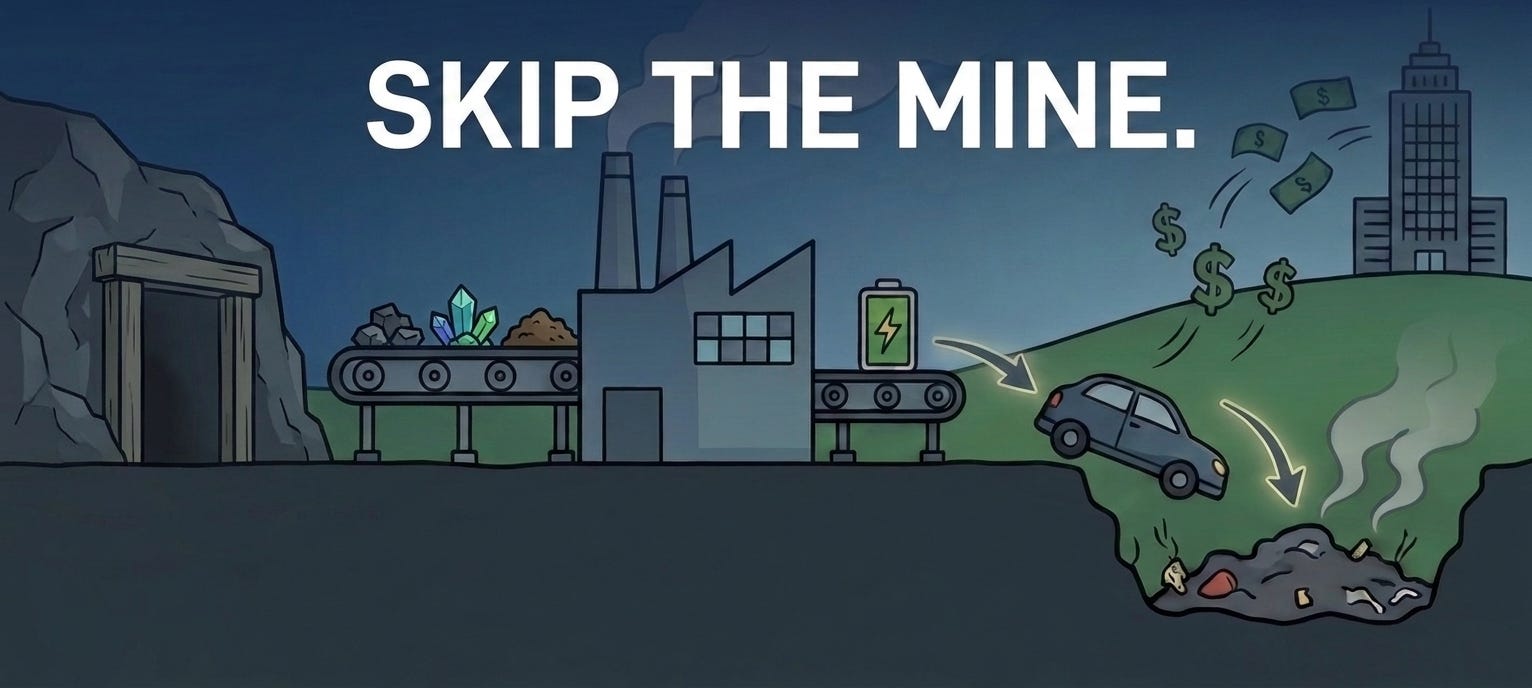
Three-quarters of all the aluminum ever produced is still in use. Recycling a can takes 95 percent less energy than smelting new aluminum from bauxite. The metal never degrades. It just changes shape. The battery industry is approaching the same curve, and the implications run deeper, because a battery stores energy, and energy is how the world moves.
The cost of the current system is written into the places where the materials come from. The Atacama salt flats in northern Chile, where the desert meets the Andes and the Atacameño people have lived for thousands of years, hold some of the richest lithium deposits on Earth. Extracting a single ton requires half a million gallons of water in one of the driest places on the planet (Harvard International Review). The salt flat is sinking at two centimeters a year. Freshwater those communities relied on for generations is being pumped into evaporation ponds. A car you plug in at night runs on water that belonged to someone else. Cobalt from the Democratic Republic of the Congo, where an estimated 40,000 children work in artisanal mines, some as young as seven, earning less than two dollars a day. Rare earths from Myanmar, where mining revenues fund a junta. Graphite from China, which controls more than 95 percent of the world’s battery-grade supply. This week, 800 wildfires are burning across Ontario, turning the sky orange over Toronto and the eastern seaboard. The extraction loop has a carbon bill, and it comes due every summer.
This month, two technologies began shipping. Both had been waiting on money the planet could have spent decades ago. Sodium-ion chemistry was explored alongside lithium-ion in the 1970s, then shelved when Sony’s 1991 camcorder battery made lithium the industry standard. The calculus was energy density for a handheld device, not what happens to the battery when it dies or whose water it took to make it. Recycling research did not become a funded priority until the 2010s, when the first electric vehicle (EV) batteries approached end of life and the volume problem became visible. Both technologies were stuck in the same waiting room for the same reason: the problems they solve were costs the market had no incentive to price in.
On July 8, a company in Oregon started shipping a battery the size of a freight container that costs less to build than its lithium equivalent and contains none of the materials that drive the current supply chain. ESS Tech calls it Bridge. Each unit stores 1.2 megawatt-hours. It contains no lithium, no cobalt, no nickel. The active material is sodium. Salt. A thousand times more abundant than lithium, extractable from seawater, distributed on every continent. The first customers are utilities and AI data centers.
CATL, the world’s largest battery manufacturer, is pricing sodium-ion cells at $19 per kilowatt-hour at volume. The cheapest lithium chemistry runs $55 to $60. Sodium-ion cells can be manufactured on existing lithium production lines, which means the world’s installed factory base can pivot without billion-dollar rebuilds. Bridge was built to serve AI data centers, and those data centers are, at this moment, the reason utilities are keeping peaker plants running. Those are gas generators fired up only when demand spikes: the dirtiest and most expensive power on the grid. At $19 a kilowatt-hour, sodium-ion undercuts them. The industry that created the demand spike is now buying the battery that makes the spike temporary.
The batteries charge at night, when demand is low and renewable energy is abundant on the grid. They discharge during the afternoon peak, when air conditioners are running and peaker plants would otherwise fire up. The battery does not generate power. It moves power from when it is cheap and clean to when it is expensive and dirty. That shift, multiplied across enough freight containers, makes the peaker plant obsolete.
Sodium-ion changes what goes into batteries. The second technology changes what comes out of them.
Redwood Materials, founded by a former Tesla engineer, runs the largest battery recycling operation in North America. Old EV packs and production scrap arrive at its Nevada facility. Cathode and anode powder leave, ready to be pressed into new cells. The company now processes roughly 90 percent of all the lithium-ion batteries recycled on the continent. It recovers more than 95 percent of the lithium, nickel, cobalt, and copper. Redwood opened a second facility in South Carolina in late 2025, backed by a $2 billion loan from the same Department of Energy (DOE) program that funded Tesla in 2010. The material that powered a Nissan Leaf in 2013 can power something else in 2033.
The infrastructure is spreading beyond one company. In July, the UK funded Altilium to scale a process that recovers 99 percent of graphite from spent batteries, with 77 percent lower emissions than primary mining. The European Union’s Battery Regulation now requires that by 2031 every EV battery sold in Europe contain at least 16 percent recycled cobalt, 6 percent recycled lithium, and 6 percent recycled nickel, and mandates that batteries be designed for disassembly. The requirements are binding and take effect in 2031.
A barrel of oil is burned once and gone. Burn it and you need another one, forever, until the well empties or the world decides to stop. This week, the Strait of Hormuz has been largely blocked by Iran since February. The United States and Iran are in the fifth month of a shooting war. Brent crude is threatening triple digits. This is what the oil supply chain looks like when it breaks: a narrow chokepoint, an armed conflict, price shocks that ripple outward. Lithium is different. It is mined once. The material that replaces it, sodium, has no chokepoints. It is in seawater and salt deposits on every continent. When a battery dies, Redwood recovers 95 percent of the metal and puts it into the next one. A system where the lithium pulled from the ground in 2026 can still power something in 2076 is a system fundamentally unlike the one it replaces.
There are limits worth naming. Sodium-ion batteries store less energy per kilogram than lithium-ion, which makes them less suited to long-range EVs and consumer electronics where every gram counts. The recycling infrastructure, while growing fast, is nowhere near the scale required to feed a global battery industry. And China, having lost none of its instinct for supply chain dominance, is moving fast on sodium-ion manufacturing just as it did on lithium refining, where it controls an estimated 65 to 70 percent of global capacity.
But these are growth problems, and growth problems have solutions. Production lines exist. The chemistry works. Recovery rates are verified. RMI, the energy think tank, projects that peak demand for mined battery minerals will arrive within a decade and that recycling, chemistry innovation, and efficiency improvements could eliminate the need for new mineral extraction entirely by 2050. Known reserves of lithium, cobalt, and nickel are already twice the level of total virgin demand. The extraction imperative was never a physical law.
In 2022, the six largest oil companies made $219 billion in profit. The oil and gas industry spent $124.4 million on federal lobbying that same year. The companies that profited from extraction had no reason to fund alternatives that would make their assets worth less. When public institutions finally built what the market refused to, the private sector raced to own it. The electric car itself followed the same arc a century earlier: commercially viable by 1900, sidelined by the oil and auto industries, resurrected by California’s zero-emission mandate and a DOE loan to an obscure startup called Tesla. Sodium-ion is the same story at the chemical layer.
Who owns the next chapter? Public science funded the foundational chemistry: DOE labs and research universities made both sodium-ion and lithium-ion possible. Public money funded the buildout. The Inflation Reduction Act’s Section 45X manufacturing credit pays manufacturers $35 for every kilowatt-hour of battery cells they produce. The Bipartisan Infrastructure Law funded a $3 billion grant round for battery manufacturing and recycling that supported 25 projects across 14 states. The Advanced Technology Vehicles Manufacturing loan program, the same one that backed Tesla in 2010, was designed to lend money too risky for private capital, get repaid with interest, and take zero equity. Redwood Materials collected a $2 billion public loan. It is now valued at $6 billion, backed by Goldman Sachs and Alphabet. The money worked. None of the output belongs to the public who funded the science, guaranteed the loans, and subsidized the production.
The chemistry and the factories were built with public money. Local municipalities are now fighting over who captures the value once the hardware is plugged in.
Ann Arbor, Michigan, is choosing a different answer. Voters approved a charter amendment in 2024 to create a Sustainable Energy Utility: a city-owned, opt-in utility running alongside the existing private grid, providing local renewable energy, battery storage, and future geothermal to any resident who signs up. The SEU is launching this fall, with roughly 1,500 residents and businesses lined up to connect. Separately, a grassroots coalition called Ann Arbor for Public Power is gathering signatures to put a second question on the November ballot: whether to replace DTE Energy entirely with a city-owned municipal electric utility. The signatures are due in August.
Ann Arbor is not alone in asking who the infrastructure serves. The virtual power plant, software that aggregates thousands of home batteries, EV chargers, and smart thermostats into a single dispatchable grid resource, passed $7.4 billion in global market value in 2026. The Federal Energy Regulatory Commission’s (FERC) Order 2222 opened wholesale energy markets to aggregated distributed resources. A home battery enrolled in a VPP stops being backup power and becomes a revenue-generating asset.
The real question is the software architecture managing the dispatch. Under the utility model, proprietary algorithms optimize for peak pricing margins. Change the ownership, and the same software serves a different priority. Tenant unions, housing cooperatives, and neighborhood associations manage their own energy profiles. They pool storage across members. They negotiate wholesale rates collectively. During a crisis, stored energy routes to critical local infrastructure first: medical devices in vulnerable households, community cooling centers. Surplus gets sold back to the broader grid afterward. The question a Midwestern college town is answering on a November ballot is whether the grid layer that captures the value belongs to shareholders or to the communities where the batteries are installed.
The technology makes a different world possible: extraction as a one-time cost instead of a recurring one, batteries that pass from one car to the next, storage built as infrastructure instead of traded as a commodity, decisions made deliberately by people with a stake in the outcome. The battery does not care who owns it. The grid does.
Batteries are the latest industry to follow this arc. Concrete, rare earths, and the water AI data centers consume in rural Oregon are all wired into the same pattern: identify a resource, mine it where the people are poor, externalize the environmental cost, call the result inevitable. Batteries are just the newest chapter. What makes this chapter different is that both ways out are already built. Change the chemistry so the sacrifice zone is unnecessary. Close the loop so yesterday’s extraction feeds tomorrow’s production. The technology for both paths exists now, in shipping containers and bonded warehouses and regulatory text, built with money the public provided. Two technologies shipping this month proved the default was never a physical law. It was a choice.
Aluminum proved the loop could close. Batteries are proving it again. The chemistry did not change between the first attempt and the one that worked. What changed was that someone decided to build it: public loans, deposit laws, manufacturing credits, the accumulated weight of enough people refusing to accept that extraction was the only way. The physics was never the obstacle. The obstacle was what we were willing to fund, what we were willing to regulate, what we were willing to imagine. Aluminum and batteries are evidence that those things can shift, and that when they do, the technology is already waiting. They are not the only path to a less extractive future. They are proof that a less extractive future is something we can choose.
CommonBytes
This column explores a central question: What should technology’s role be in a world beyond capitalism? Today’s technological landscape is largely shaped by profit, commodification, and control—often undermining community, creativity, and personal autonomy. CommonBytes critiques these trends while imagining alternative futures where technology serves collective flourishing. Here, we envision technology as a communal asset—one that prioritizes democratic participation, cooperative ownership, and sustainable innovation. Our goal? To foster human dignity, authentic connections, and equitable systems that empower communities to build a more fulfilling future.
This is a great material analysis of the battery industry, rousing optimism about a better future, and a strong argument for why the public are the rightful owners and beneficiaries of our shared environments all in one. Thanks for writing it!
Thank you. This is important information and offers a path forward. The question’s I have are: Will this transition continue to satisfy the energy and material needs of 8.3 billion+ people? Will those that are invested in the growth imperative be a willing participant in this transition, or will they continue to use extreme violence to get their expected return on investment? And if so, what pathway can be offered to subdue their genocidal and ecocidal ways?