
Everyone's AI
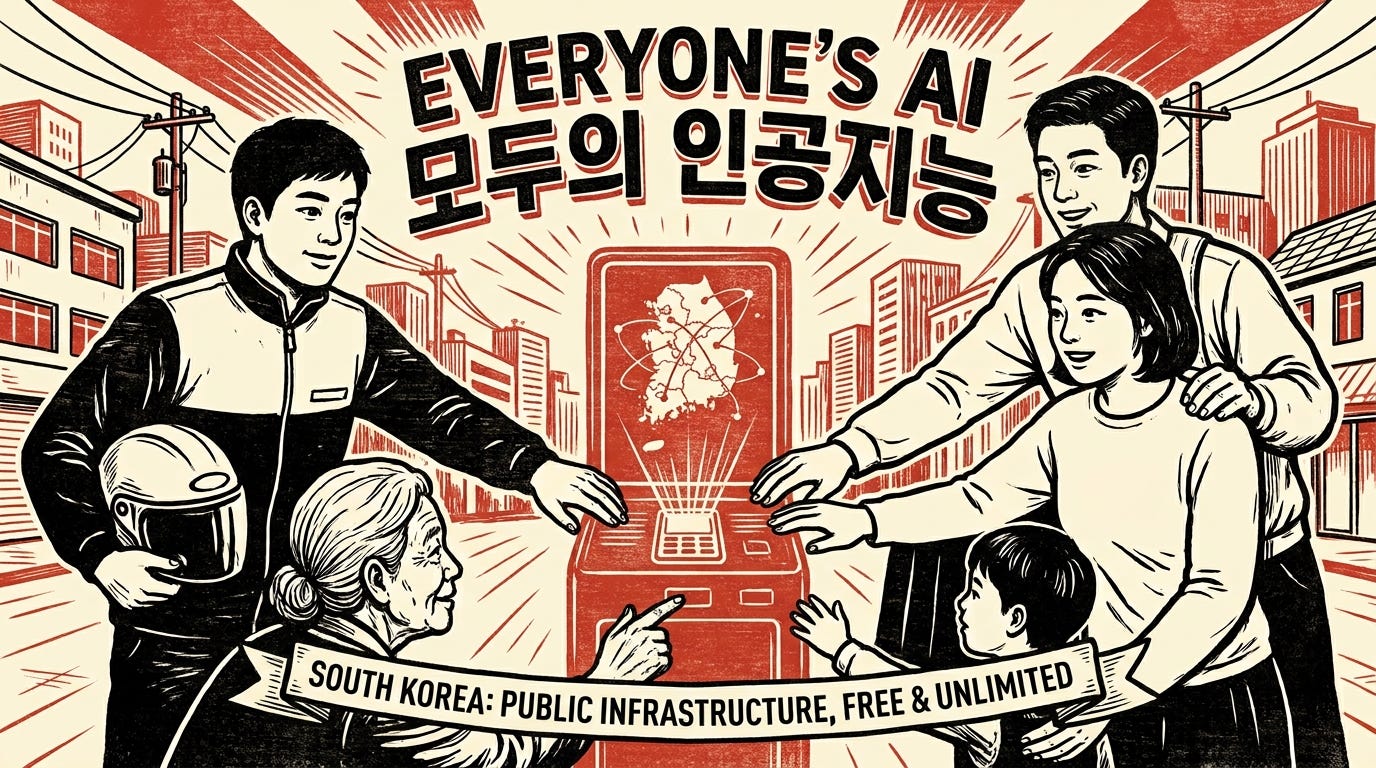
South Korea just became the first G20 country to treat AI as public infrastructure: free, unlimited, for 52 million people. The name of the program is also the question.

OpenAI has 23 million users in South Korea. Fewer than two million of them pay. From San Francisco’s perspective, that is a conversion problem: 21 million free riders who need to be nudged toward a subscription. From Seoul’s perspective, that is a structural dependency: 21 million people whose access to a tool they already depend on could disappear with a pricing change, a corporate strategy shift, or a geopolitical restriction on compute exports.
On July 13, the South Korean government opened bidding for a different answer. The program is called Everyone’s AI: a free, unlimited chatbot for everyday use, plus a public-service agent that finds the benefits you qualify for and helps you apply, the heating subsidy the retiree never heard of, the housing support the part-time worker never had time to chase. Two or three private companies will build it, with the government supplying up to 512 Nvidia B200 GPUs and requiring the winners to match that compute with their own funding. At least half the system must run on domestic Korean AI models, with another thirty percent sourced from other Korean companies, a combined mandate that puts the public AI on an approximately 80 percent Korean supply chain. The bidding closes August 11, a beta follows in September, and full service goes live by the end of the year, free through 2028. Fifty-two million residents, and no other G20 government has tried it.
You have used a free AI chatbot, so you know the rhythm: three good answers, then the cutoff, the model capable of more but the company deciding you have received enough free intelligence for one day. South Korea looked at the same technology and asked why the cutoff should exist at all, when serving one more citizen costs the provider almost nothing and the state could carry the fixed cost the way it already does for public roads. If your first instinct is suspicion, it is earned, because the state handing money to private companies is the oldest trick in the book, socialize the costs, privatize the profits, and on paper this is that arrangement, two or three firms building on government GPUs. The difference is what the money buys this time. A chip subsidy ends in a private factory and a product the public still pays market price for. This one ends in a service every resident can use without paying, on terms the state sets.
The decision stops looking radical once you start counting. Add up ChatGPT, Gemini, and Claude and you get more than thirty-four million Korean users, all but 1.8 million of them on free tiers that one pricing change or one export restriction could take away. The dependency has a shadow: the survey behind the program found 59 percent of the country already uses AI, but only 32 percent of digitally vulnerable Koreans, older adults and low-income residents, have touched it at all. That 27-point spread is what the government named a digital divide and decided to close with public money.
The program sits on top of a legal and industrial apparatus that has been under construction for years. This is a country deciding that AI is a layer of national infrastructure and building the architecture to match. The AI Basic Act, effective January 2026, was Asia’s first comprehensive AI law, with a National AI Committee chaired by the president and risk-based obligations for high-impact AI in healthcare, employment, and finance. The K-Moonshot initiative commits $7.5 billion through 2035, and total sovereign investment, public and private combined, approaches $735 billion.
The domestic model mandate is the tell. Five Korean consortia, led by Naver, LG, SK Telecom, Upstage, and NC, have been competing since August 2025 to build sovereign AI models. Naver’s HyperCLOVA X was trained on 6,500 times more Korean-language data than GPT-4, all five teams must open-source more than half their models, and the government will cut the field to two finalists by 2027. The program is funded by the chip tax windfall generated by Samsung and SK Hynix, the semiconductor giants whose profits have soared during the AI boom: the companies extracting value at the silicon layer are partially funding the service that delivers AI to every citizen at the application layer. It is the closest thing to a closed loop between AI’s winners and the public that any G20 country has built.
The conventional reading stops here: visionary industrial policy from the country that already ranked first in the OECD’s Digital Government Index, already built 99 percent 5G coverage. The AI chatbot is the logical next step on infrastructure Korea has been building for two decades. The story writes itself.
And then you read the Korean-language coverage, and you talk to the people who are not celebrating.
On the day the AI Basic Act took effect, four civil society organizations, Minbyun’s human rights lawyers among them, greeted it with a joint statement: the law that made Everyone’s AI legally possible contained almost no provisions to protect citizens from AI risks. The Act covers developers but not end users. The EU’s AI Act reaches deployers and consumers alike; Korea’s stops at the company building the model. The same law that enables public AI access does not give the public meaningful rights over how the AI uses their data, what it records, or who can access the logs. The government has not published transparent data-handling protocols for the public system. Can law enforcement query citizen conversation logs? Can the intelligence services access usage patterns? Is query data used to train future government models? The bidding documents do not say.
The domestic precedent is not reassuring. In the last days of 2020, a startup called ScatterLab launched Luda, a chatbot built to simulate a twenty-year-old college student, and users were encouraged to talk to her every day, the way you would text a friend. They did not know she had been trained on more than ten billion lines of private conversation collected through a dating-advice app, and within weeks people were watching her repeat real names, real addresses, and real bank account numbers from strangers’ private messages. ScatterLab pulled her offline exactly twenty days after launch. The maximum fine for leaking personal data under Korean law at the time was roughly $18,000. The AI textbook initiative, a separate government program to deploy AI-powered education tools, failed to achieve adoption. The country’s surveillance infrastructure has been expanding for over a decade. South Korea suspended downloads of DeepSeek in 2025, citing privacy concerns about data collection. The government understands that AI systems collect data in ways that threaten privacy. It has applied that logic to a foreign competitor. It has not explained why the same logic does not apply to a government-operated AI that 52 million people will use.
The content question is equally unresolved. South Korea maintains some of the most aggressive internet content regulation among democratic countries. The Network Act has drawn explicit warnings from the U.S. government about free speech and censorship risks. A law targeting fake news took effect over the objections of journalists’ groups who warned it could be used to suppress legitimate reporting. The Korea Communications Standards Commission orders tens of thousands of content takedowns annually. A chatbot the state operates under these laws cannot be a neutral information platform. By definition, it reflects the state’s content priorities. Will it disclose when it is restricting a response due to content laws, or will it silently omit? The bidding documents are silent on this too.
The doubts so far are about what the state might do with the system it operates. Whether the program can succeed on its own terms is a different problem, and it runs through Kakao. KakaoTalk is the platform 97 percent of Korean internet users rely on for messaging, payments, commerce, and content. It is Korea’s digital public square in everything but name. Kakao sat out the sovereign model race, and in February 2025 it signed a partnership with OpenAI to build AI products for KakaoTalk, betting its own services on American infrastructure. Then Everyone’s AI opened for bids, and Kakao declared its candidacy the next day. The company wants to operate the public option too, which would mean running mostly other firms’ Korean models alongside its own OpenAI integration, in the same app. However the bidding resolves, the public AI’s reach depends on distribution the state does not control, and the company that controls it has already hedged both ways.
And the funding model is not what the infrastructure framing implies. The government plans to cover operating costs “from next year,” but the size of the funding has not been determined. The “free through 2028” in the program’s pitch is a deadline, and the bidding notice says what surrounds it: government support ends on December 31, 2030, and operators must build “their own revenue models” to keep the service running, with the ministry itself naming the asset, the user prompt data the service collects. The expectation of monetization is written into the program from day one, before any subsidy lapses. That is not a road. Roads do not have a sunset clause. Roads do not anticipate operators making money from user behavior. The profits half of the old trick survives in the fine print. The infrastructure language describes what the program wants to be. The budget language describes what it is: a time-limited tender with an expectation of private monetization, dressed in the rhetoric of public goods.
Even if the funding holds, the quality problem is structural. Korean sovereign models operate in the 7 to 32 billion parameter range, while frontier American models operate at effective scales well above 100 billion. The Korean models are genuinely excellent at Korean-language tasks: HyperCLOVA X beats GPT-4 on Korean-specific benchmarks. They trail the frontier on complex multi-step reasoning, multilingual queries, and creative generation, exactly where smaller models fall behind. The government’s target is 95 percent of frontier model performance. Even if they hit it, that last five percent means a Korean citizen who can afford ChatGPT Plus gets a meaningfully better tool for high-stakes tasks than a citizen who relies on the public option. Universal access does not mean universal capability. The same program designed to close the digital divide may produce a two-tier system in which the wealthy use both and everyone else gets the government model.
None of these concerns are arguments against public AI. They are arguments for public AI that is accountable. The distance between where Korea’s program is and where it needs to be is measurable, and it is fixable. What was never fixable, under the alternative, was the structural dependency of thirty-four million people on products they do not own and cannot govern. Karl Polanyi described this dynamic eighty years ago: the market reaches into a domain that was never meant to be a commodity, society organizes to pull it back. He was writing about land and labor. The pattern generalizes to AI without modification. One country’s vulnerability is another country’s business model. The technology does not care which framing wins. The people who use it do.
If the program works, it will be because things happen that are not in the bidding documents. It needs a legal firewall between the citizen-facing AI and the state’s surveillance infrastructure, with an independent auditor that includes civil society representation. The organizations that criticized the AI Basic Act on day one deserve formal oversight: Minbyun, the digital rights groups, the journalists’ associations identified the weaknesses the government missed. It needs mandatory disclosure when content is restricted, so the system tells you when it is complying with a content law rather than silently redirecting. It needs published benchmarks against ChatGPT, Claude, and Gemini on Korean-language tasks, updated quarterly. If the shortfall is five percent, own it. If it is twenty, the public should know. It needs parliamentary authorization for post-2028 funding. A program that touches 52 million people should not live or die on one ministry’s budget line.
None of these require dismantling the program. They require transparency and independent oversight, the things that distinguish public infrastructure from state capture. South Korea already has the civil society organizations, the democratic institutions, and the public attention to hold the program accountable. The question is whether the government that built it lets them.
Every country with the resources to build public AI infrastructure and the political will to treat access as a right can do what South Korea just did. The accountability mechanisms are not theoretical. They are the difference between a public utility and a surveillance apparatus with a friendly name.
There is a step past accountability. The state providing AI is an improvement over a handful of companies providing it, and communities governing their own AI is an improvement over the state providing it.
In Kaitaia, New Zealand, the Māori community nonprofit Te Hiku Media built a language model from scratch to revitalize te reo, the endangered Māori language. They collected 310 hours of recordings from 2,500 speakers in ten days, bought GPUs at a discount, trained the model locally on open-source tools, and created a custom license ensuring their data could never be used against the community. This is not a pilot. It is not a state project. It is a community that looked at AI and said: this is ours.
A Library of Congress pilot with Metagov and Public Knowledge is now placing AI workstations in public libraries across five states, the next chapter after makerspaces brought 3D printers and laser cutters into communities that could never afford them individually. Each kiosk costs a library a thousand dollars a year. Instead of every patron paying for AI access on their own, the library provides it the way it already offers internet access, books, and community meeting rooms.
Nothing in the technology requires a central authority any more than it requires a private owner. It requires compute, data, and a governance structure. Who provides the governance is a political choice. Public infrastructure is the step South Korea just took. Community ownership is the step that infrastructure makes possible.
The U.S. default is a private infrastructure that answers to shareholders, converts users into revenue, and calls the result innovation. South Korea just proved the alternative is buildable. The test is whether the country that built it can hold the bar where it set it. The next test is who raises it higher.
CommonBytes
This column explores a central question: What should technology’s role be in a world beyond capitalism? Today’s technological landscape is largely shaped by profit, commodification, and control—often undermining community, creativity, and personal autonomy. CommonBytes critiques these trends while imagining alternative futures where technology serves collective flourishing. Here, we envision technology as a communal asset—one that prioritizes democratic participation, cooperative ownership, and sustainable innovation. Our goal? To foster human dignity, authentic connections, and equitable systems that empower communities to build a more fulfilling future.
I'm all for it. Bernie Sanders is proposing the American AI Sovereign Wealth Fund Act, which would levy a tax to create a fund that would provide payments to every American and also help pay for necessary public services.
I've had conversations about movies and books with AI that have gone on for days . . .