
Dismantling the Engagement Engine
The EU’s new ruling doesn’t just patch a bug in social media—it demands a complete rewrite of the ad-supported internet's core architecture.

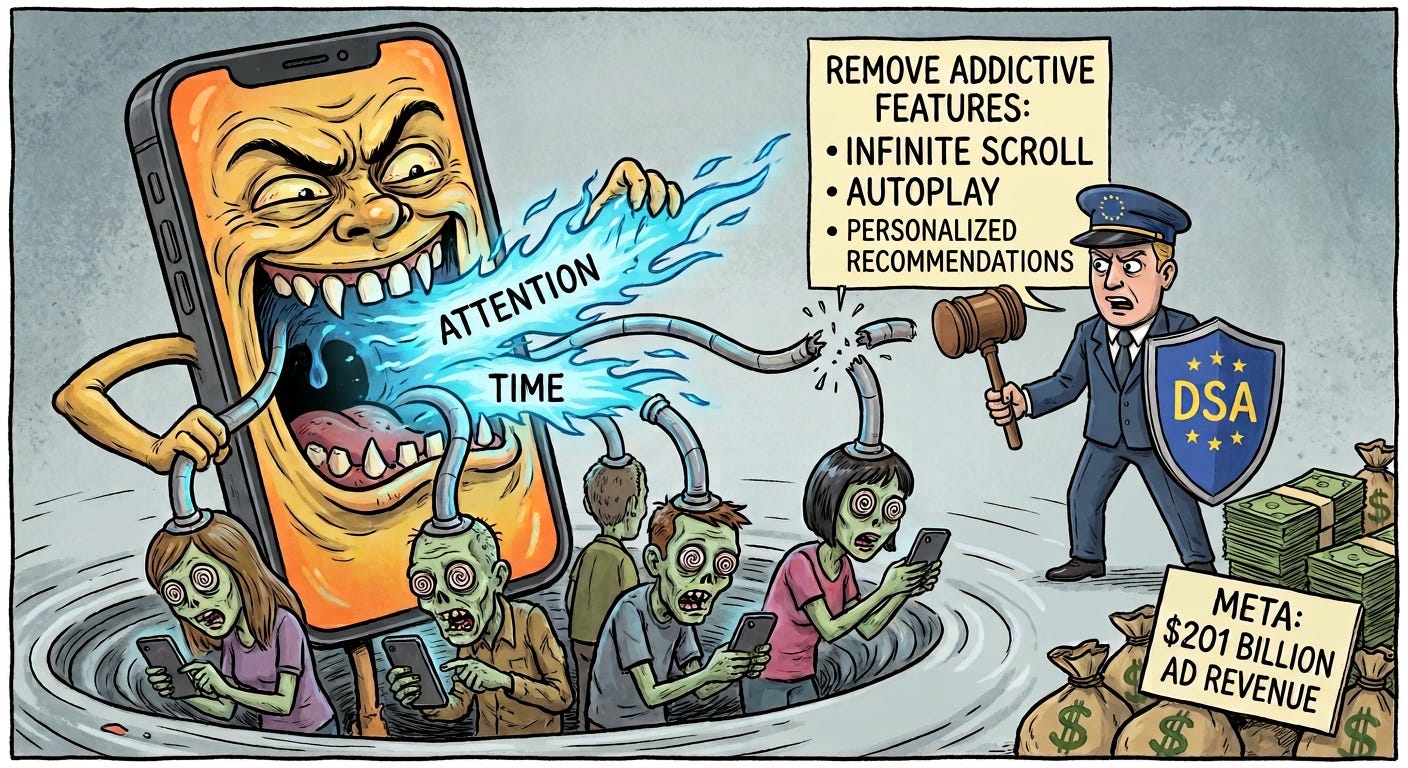
The man who invented the infinite scroll, Aza Raskin, eventually testified against the company that built a business on it. On July 10, acting under a Digital Services Act (DSA) mandate, a regulator in Brussels agreed with his underlying premise. The European Commission’s finding is blunt: autoplay, infinite scrolling, personalized recommendations, and push notifications shift the brain into “autopilot mode,” a state of compulsive scrolling in which conscious choice shuts off. The Commission told Meta to disable the features that keep users glued to the platform. It ordered an end to the endless feeds that are the internet, the autoplay that is every video, and the engagement optimization that the advertising industry has historically called good design.
Autoplay, infinite scrolling, personalized recommendations, and push notifications shift the brain into ‘autopilot mode’: a state of compulsive scrolling in which conscious choice shuts off.
The industry has spent two decades optimizing for engagement: daily active users, time on platform, and ad revenue per user. Product after product, human attention was harvested and sold. Advertising became the default model of the internet, not because it was the only one, but because it was the most profitable.
Meta is what that design produced. The company generated $201 billion in revenue last year, and 98 percent of it came from advertising. That advertising runs on the exact mechanisms the European Commission has now ordered it to remove: the video that starts before you decide to watch it, the feed tuned to hold your gaze, the scroll with no natural stopping point. The finding is explicitly about protecting minors, but the mechanism it targets is the engine of the entire ad-supported web. TikTok received the same order. YouTube, and X are all built on it.
Advertising became the default model of the internet, not because it was the only one, but because it was the most profitable.
When an industry is told its product causes harm, it follows a familiar playbook. It denies. It funds research that says the opposite. It extracts for as long as the system permits. Tobacco companies denied for decades that cigarettes were chemically engineered to be more addictive than the leaf; Purdue Pharma marketed OxyContin as non-addictive pain relief long after internal memos proved otherwise; oil companies understood fossil fuels were warming the planet, commissioned the research that confirmed it, and spent forty years running a public denial campaign. Instagram followed the same arc. It launched as a simple photo-sharing app and added addictive features, one update at a time, until the platform became a machine for auctioning attention. Two decades passed before a regulator finally told the industry to dismantle what it had built. The research was public by then. The internal documents were damning. Last week’s finding is the bill for those years finally arriving.
Meta has known since at least 2021 that Instagram exacerbates body image issues for teenage girls. Internal research, released by whistleblower Frances Haugen, found one in three teen girls were negatively affected, and 13 percent of British teens traced suicidal thoughts directly to the platform. When the EU asked Meta to assess the risks its product creates, the company responded with a philosophical deflection: the risk is everywhere, and therefore nowhere. There is nothing specific to fix.
Instead of changing the design, the company points to safeguards that exist largely on paper. Meta’s spokesperson claimed the EU’s conclusions “don’t accurately take into account the significant steps we’ve taken to protect teens,” pointing to Teen Accounts introduced in 2024. But 16- and 17-year-olds can opt out of those protections on their own. A recent independent study found that 66 percent of the platform’s safety tools were either non-functional or deliberately hard to find; the timer designed to limit your usage is designed to be easily dismissed. Teen safety is the only discussion Meta can afford to have, because regulating the mechanism for everyone would crash the ad auction. A number of countries, following Australia’s world-first ban in 2024, are moving to block young teens from social media entirely. An age ban merely concedes the product is harmful while leaving the platform intact for everyone else. True design regulation says the harm should not be built into the product at all, for anyone.
An age ban merely concedes the product is harmful while leaving the platform intact for everyone else. True design regulation says the harm should not be built into the product at all, for anyone.
This mechanism is a system designed to bypass conscious choice and pull directly from the body. The thumb moves before the brain decides. People originally came online to reach out, to feel connected, and to participate in a digital revolution. What the feed now delivers is simply what the algorithm has decided will hold their gaze: a video tuned to provoke anger, an ad that follows you for weeks, a post optimized to steal another minute. You notice only when you surface forty minutes later, feeling worse, unable to name what just happened.
Platforms generate hundreds of billions in revenue by making billions of users feel worse. Ad impressions are countable. What those impressions cost has no column in the spreadsheet.
Multiply what happens to one person by three billion. The minutes the platform takes are minutes not spent on anything else, and what is lost is not just the time. It is the conversation that did not happen because both people were lost in their feeds; the relationship that thinned because the scroll replaced the phone call; the idea that never surfaced because the silence where ideas form was filled with autoplay. Capitalism stakes its legitimacy on productivity, and these platforms are what that productivity produced: the most successful advertising corporations in history, generating hundreds of billions in revenue by making billions of users feel worse. Ad impressions are countable. What those impressions cost has no column in the spreadsheet. The model requires the ledger to remain incomplete.
This is not merely a technological issue; it is a labor issue. Capital has always treated the body as raw material: a site of accumulation, a commons to be enclosed. Scholar Silvia Federici described this forty years ago when writing about how capitalism extended its enclosure past the physical field and into the domestic lives of women.
Capital has always treated the body as raw material. ‘Autopilot mode’ is simply the moment when extraction bypasses consent.
The mechanism the European Commission just named operates on the same principle. “Autopilot mode” is simply the moment when extraction bypasses consent.
The July 10 finding is not the final word. Meta will dispute it, and the appeals process will take years. The company will argue that the Digital Services Act was designed to regulate illegal speech, and that its mandate stops at policing posts, not re-engineering the feed. The Commission has already signaled it disagrees. If regulators prevail, the consequences extend far beyond Meta. Every app that autoplays the next video before you decide to watch it will face the same existential threat. Making the mechanism gentler or slapping a warning label on it leaves the engine intact. The EU is asking whether the engine should exist at all.
Alternatives prove another model is possible. Wikipedia serves billions of pages a month without an engagement-maximizing algorithm. Signal provides encrypted messaging to hundreds of millions without auctioning their attention. Both are funded by donations, and neither depends on keeping users trapped on the platform. The DSA finding marks the first time a regulator has told a tech giant to remove its core revenue-generating features on the grounds that they cause inherent harm.
Meta’s fiduciary duty is to maximize shareholder return, and $201 billion in ad revenue is what that looks like. Morality is not a lever the system recognizes. Changing the default requires changing the system that built it. You opened the app to check one thing. Forty minutes disappeared. A regulator in Brussels has finally told the company to remove the features that took them. The ruling can change the design, but it cannot change the business model, and the business model is what ultimately has to give.
The ruling can change the design, but it cannot change the business model, and the business model is what ultimately has to give.
CommonBytes
This column explores a central question: What should technology’s role be in a world beyond capitalism? Today’s technological landscape is largely shaped by profit, commodification, and control—often undermining community, creativity, and personal autonomy. CommonBytes critiques these trends while imagining alternative futures where technology serves collective flourishing. Here, we envision technology as a communal asset—one that prioritizes democratic participation, cooperative ownership, and sustainable innovation. Our goal? To foster human dignity, authentic connections, and equitable systems that empower communities to build a more fulfilling future.
This is disturbing read. All these claims being made without one citation from a peer reviewed study; like it’s settled science. It’s nothing of the kind. We must be careful not to slip down a slippery slope to censorship. But we have to protect the girls! How many times have I heard that one?