
Connected and Captured
Starlink solved the rural broadband problem. Then it made sure no one else could.

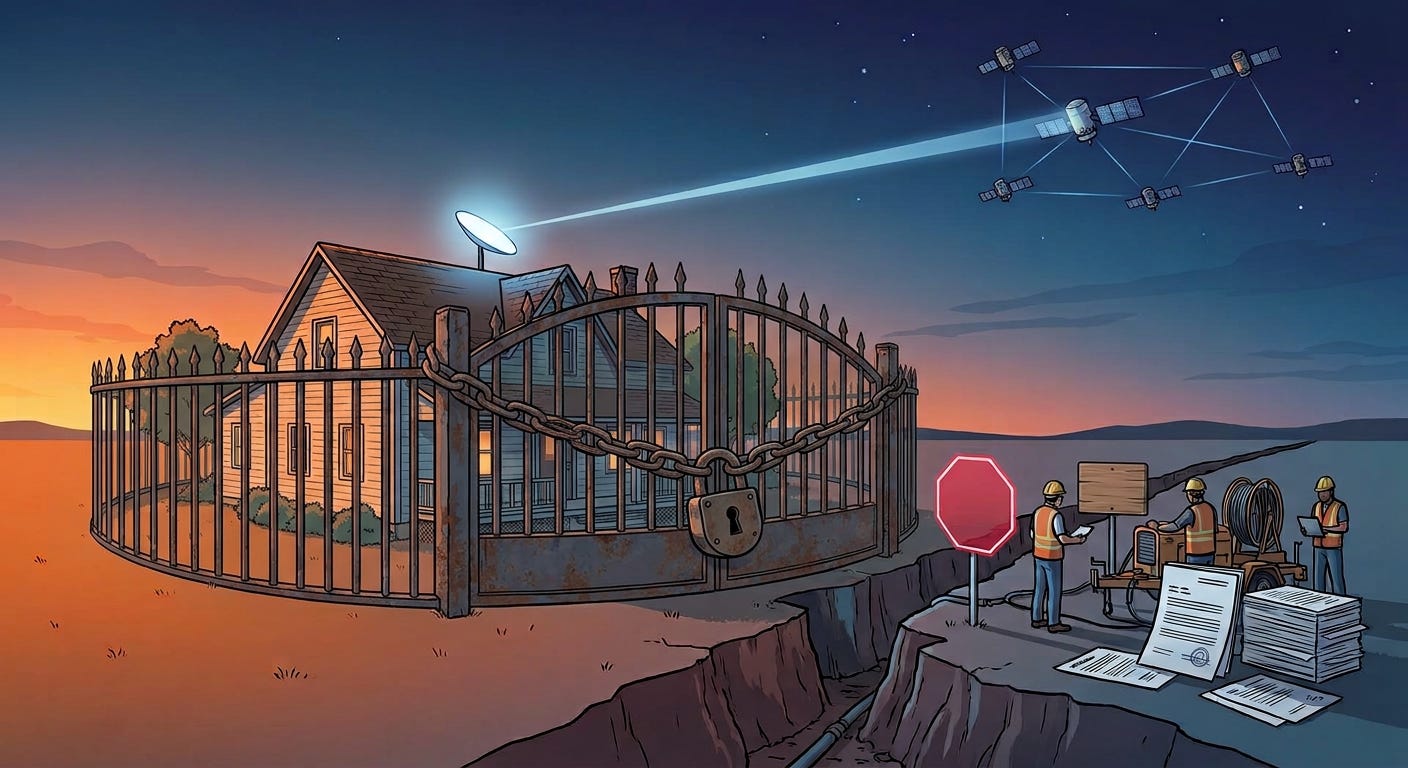
In June, the Washington Post documented a pattern that Julie Slama already understood without needing to read about it. She had moved to Dunbar, Nebraska in 2022. Population: 170. Starlink was the only option that worked, and she paid $90 a month. This spring, the company told her the bill was going up 44 percent, nearly five hundred dollars more a year, and there is no other provider to call. Austin Schmit, a nurse anesthesiologist in Crete, put a hole in his roof for the Starlink dish and learned his $59 monthly bill would more than double. He had been a customer for four years.
If you have ever typed your zip code into a broadband availability map and watched it come back empty, or called an ISP and heard that your road was too far from the nearest connection, you already know the feeling. Sascha Meinrath, a broadband researcher at Penn State, calls it “archipelagos of regional monopolies.” The network that finally reached the places no one else would reach is now raising prices on customers with nowhere to go, lobbying against fiber funding, and locking new customers into hardware they can no longer buy — only rent, forever.
The pattern is older than the satellites. For decades under the old Bell System, AT&T served rural America through a regulated monopoly: urban subscribers subsidized rural ones under a compact that required universal service. The 1984 breakup dismantled the cross-subsidy. The government replaced it with direct payments to private companies, which took the money and built where the returns were highest. The Telecom Act of 1996 was supposed to bring competition to every market. Competition arrived in the cities, sort of. The cable companies upgraded their coax networks and called it broadband. The phone companies kept running DSL over copper lines installed for voice calls. Fiber deployment crawled, because the companies that owned the copper and coax had no incentive to replace infrastructure that was already generating returns. More than $100 billion in federal subsidies later, roughly 14 million rural households still had no broadband when Starlink began service in 2021. The companies got paid. The buildout never came, in the countryside and in large parts of the cities too.
The subscriber density that made fiber unprofitable made Starlink profitable, because a satellite does not care whether the ground below it has one house or a thousand. The company was awarded $885 million from the FCC’s Rural Digital Opportunity Fund, but the FCC revoked the award after determining Starlink “failed to demonstrate” it could deliver the promised speeds. When Starlink began service in 2021, it had received no broadband subsidies. The launch platform was a different story. NASA’s $1.6 billion Commercial Resupply Services contract saved SpaceX from bankruptcy in 2008 and funded the development of the Falcon 9, the rocket that carries every Starlink satellite into orbit. The public paid for the rockets. The network that rides on them was built with venture capital and commercial launch revenue: more than $10 billion in satellites and launches. In 2025, it generated more than $4 billion in profit on $11.4 billion in revenue from 12 million subscribers across 160 countries.
In May 2026, Starlink raised rates on nearly every residential plan, in nearly every country. The cheapest US plan went from $50 to $55. The mid-tier: $80 to $85. The premium: $120 to $130. Standby mode, the plan for customers who keep Starlink as a backup, doubled. Canada, the UK, Australia, France, Mexico: all hit. Only one plan, the Roam 300GB at $80, was spared.
Starlink described the hikes as a response to “ongoing improvements” and “rising global operating costs,” while gross margins were expanding and profit was growing faster than revenue. SpaceX went public on June 12 in the largest IPO in history, raising $86 billion. Elon Musk became the first trillionaire. The price hikes on 3 million captive customers had made the revenue numbers look better for Wall Street. Drew Garner at the Benton Institute for Broadband and Society: “When you have a captured consumer you are able to raise the prices. Given that broadband is an essential service and that the consumer has to buy it, you’re able to squeeze them.”
A month later came the equipment change. New residential customers can no longer buy hardware outright; the $349 dish is now a mandatory $10 monthly rental. Over three years, that comes to $360 for hardware you will never own, slightly more than the purchase price. Over five years: $600. Over a decade of rural living: $1,200. The dish only works with Starlink. There is no other provider to take it to. Canceling means disconnecting. This is the logic of the monopoly, and the logic is older than Starlink.
Capital extracts from what it owns. It also prevents anything better from being built. The economist Thorstein Veblen named this the conscientious withdrawal of efficiency a century ago. The cable and phone companies that refused to upgrade their copper and coax were practicing it. Starlink is practicing it now. The technology changes. The logic does not.
At the same time it was raising prices, SpaceX was lobbying to keep alternatives from being built. The company sent letters to states telling them to steer BEAD funds toward satellite instead of fiber, and asked the FCC to wind down a $4.5 billion subsidy program for competing ISPs, arguing Starlink had “effectively solved” rural broadband. The message: we handled it, stop helping anyone else try. Meanwhile, a SpaceX executive confirmed the company would not lower prices for customers in areas covered by BEAD funding even if the grants came through. The government money would arrive. The prices would stay where they were.
Nebraska shows where that leads. The state was allocated $400 million in BEAD funding. Governor Jim Pillen proposed spending less than $45 million of it, calling for a satellite-friendly alternative. Satellite now accounts for over a third of Nebraska’s proposed awards, the same state where Julie Slama’s bill went up 44 percent and Austin Schmit’s is doubling. The government program designed to connect rural Americans is paying the company that is raising prices on rural Americans.
Commerce Secretary Howard Lutnick made the BEAD program “tech-neutral” nationally in March 2025, a rule change that made Starlink eligible for grants it would not have qualified for under the old fiber-first rules. He called it a strike against “woke mandates, favoritism toward certain technologies, and burdensome regulations.” The change came four months into the Trump administration. Musk had spent at least $290 million to help elect Trump. The fight for broadband customers was won with campaign contributions and a regulatory rewrite. The $42 billion program was rewritten to benefit the donor who helped put the administration in power. Austin Ahlman, a Nebraska congressional candidate who previously researched SpaceX for the Open Markets Institute: “SpaceX has been doing everything possible to create this myth that they are some altruist serving rural residents out of the kindness of their hearts. They’re monopolizing the market and calling it doing us a favor.”
The critique is sharper when you acknowledge what the technology actually does. The satellites work because engineers made them work. In Ukraine, the network they designed kept hospitals connected during blackouts when Russian strikes took down the terrestrial grid. In the Aleutian Islands, in villages in the Philippines, in parts of sub-Saharan Africa, people who had never had broadband got connected because thousands of technicians launched and maintained a constellation of satellites. The hardware got cheaper to manufacture, and for years the savings passed to customers. The dish fell from $599 at launch to $199. Then Starlink eliminated the purchase option, making the dish rental-only at $10 a month. The cheapest plan is $50 a month. For a community with no other connection, a $50 monopoly is better than no connection at all. Twelve million subscribers signed up because the technology solved a real problem. Solving it and controlling it turned out to be separate things. The $10 billion created a network that reaches 12 million people across 160 countries, but the engineers who designed the satellites do not set the price. The subscribers in Dunbar and Crete do not vote on the rate increases. A company answers to shareholders. The obligation to maximize returns does not pause when customers have nowhere else to go. It becomes the business model.
And still, people build. Chattanooga, Tennessee’s Electric Power Board built a municipal fiber network in 2010: gigabit internet, lower prices than Comcast, higher customer satisfaction. The telecom industry spent millions lobbying the state legislature to ban other Tennessee cities from doing the same, and sixteen states now have laws restricting or prohibiting municipal broadband, most written by the cable and telecom lobbies. Colorado repealed its ban in 2023. The vote was bipartisan. The public option is illegal in most of the country, but the bans are breakable.
Rural electric cooperatives, the model that brought electricity to the countryside when private utilities refused to build the lines, are laying fiber across the Midwest and Plains states. In central Virginia, Firefly Fiber Broadband, a subsidiary of the local electric cooperative, just connected its 45,000th home to gigabit fiber. North Dakota’s co-ops have wired some of the most sparsely populated counties in America with service that is faster and cheaper than Starlink. These are cooperatives. The people who use the service own it. The model works everywhere it has been allowed to try.
Starlink connected rural America when no one else would, and it is now lobbying to make sure no one else can. For Julie Slama in Dunbar, for Austin Schmit in Crete, for the millions of Americans the cable maps forgot, the question is who gets to charge for it, and whether the people paying have somewhere else to go.
CommonBytes
This column explores a central question: What should technology’s role be in a world beyond capitalism? Today’s technological landscape is largely shaped by profit, commodification, and control—often undermining community, creativity, and personal autonomy. CommonBytes critiques these trends while imagining alternative futures where technology serves collective flourishing. Here, we envision technology as a communal asset—one that prioritizes democratic participation, cooperative ownership, and sustainable innovation. Our goal? To foster human dignity, authentic connections, and equitable systems that empower communities to build a more fulfilling future.